

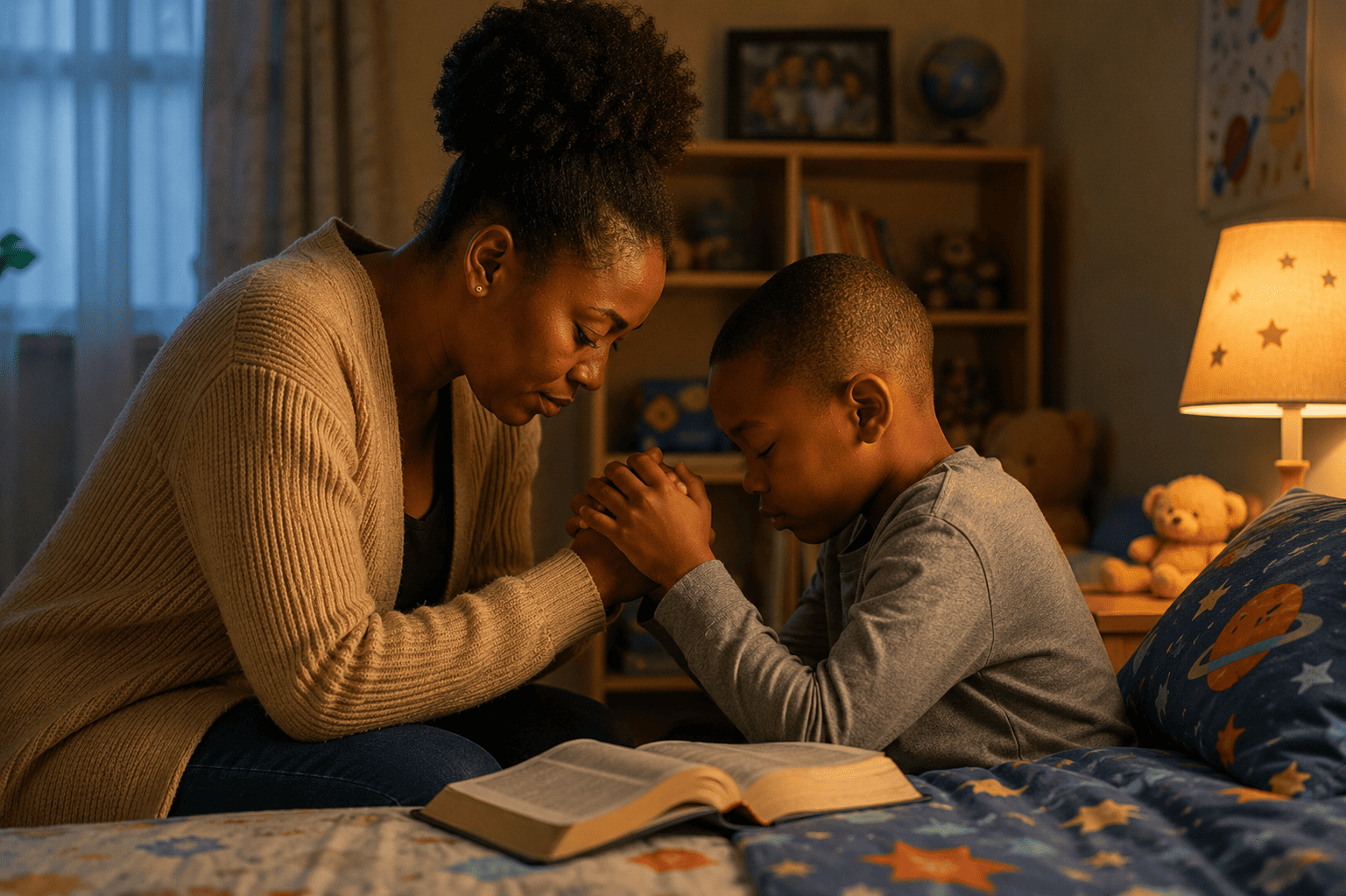
Most parents teach their children to pray the way they were taught: a memorised line at bedtime, grace before meals, and the hope that something takes root.
Sometimes it does. Often what takes root is the form without the substance — a child who can perform a prayer fluently and has never once spoken to God about anything that actually mattered to them.
The difference usually comes down to whether prayer was taught as a recitation or as a relationship, and whether what was asked of the child matched what they were developmentally capable of.
What follows is a stage-by-stage guide. The ages are approximate; children vary enormously. Move at your child’s pace rather than the chart’s.
Ages 0–2: Before they can pray
Nothing is being taught yet in any formal sense. What is being built is association.
A child at this age is learning that certain moments have a particular quality — a lowered voice, a hand on the head, a settled calm before sleep. They do not understand the words. They absorb the atmosphere completely.
What to do:
- Pray over them out loud at bedtime, briefly, in your normal voice
- Let them see you pray, including when you think they are not watching
- Keep it short. Thirty seconds is plenty
What not to expect: participation, stillness, or comprehension.
Ages 2–4: Prayer as talking
This is where it begins properly, and the key insight is simple: at this age, prayer should sound exactly like talking, because that is the only mode the child has.
Toddlers are concrete, repetitive, and entirely uninterested in abstraction. They will thank God for the dog, the biscuit, and their shoes. This is not a lesser form of prayer that needs correcting. It is a child understanding, correctly, that God is interested in what they are interested in.
What to do:
- Model very short prayers: “Thank You God for today. Please help us sleep well. Amen.”
- Invite one contribution: “What should we say thank you for?”
- Accept whatever they offer without editing it
- Let them repeat the same prayer nightly if they want — repetition is how they gain confidence
What not to do: correct their theology, extend the length, or make them pray when they refuse. A child forced to pray learns that prayer is a compliance test.
Ages 5–7: Prayer as structure
Now they can hold a simple framework in mind, and structure genuinely helps. Left with no shape at all, children this age tend to produce a list of requests and stop.
A simple pattern many families use is thank you, sorry, please, and please for others — gratitude, confession, request, intercession. It gives the child four handles and takes about ninety seconds.
What to do:
- Introduce one simple pattern and use it consistently for months
- Start teaching them to pray for other people by name — a grandparent, a friend, a sick neighbour
- Begin praying together at times other than bedtime, so prayer is not only associated with sleep
- Answer their questions about how prayer works honestly, including “I don’t know”
Watch for: the child who prays beautifully to please you. Praise the honesty of a prayer rather than its eloquence, or you will train performance.
Ages 8–10: Prayer as their own
The critical shift. Up to now the child has largely been praying with you. This is the stage where prayer either becomes something they do independently or quietly becomes a family ritual they participate in without ownership.
Children this age begin to notice that some prayers are not answered the way they hoped, and they will ask about it. How you handle that determines a great deal.
What to do:
- Encourage a short private prayer time of their own — two or three minutes, unsupervised
- Give them a simple notebook to write prayers and note what happens, if they like writing
- Let them pray aloud for the family sometimes, and do not correct them afterwards
- Take the unanswered-prayer question seriously. Do not explain it away. “I’ve asked God that too and I don’t fully understand it” is a better answer than a tidy one that is not true
Watch for: the beginning of a gap between what they say in front of you and what they actually think. Keep the questions welcome.
Ages 11–13: Prayer under pressure
Early adolescence brings self-consciousness, and praying aloud in front of family can become excruciating for reasons that have nothing to do with faith.
Simultaneously, this is when real difficulty often arrives — friendship trouble, academic pressure, the first genuine experience of not being okay. Prayer becomes either useful to them or irrelevant, and it often depends on whether they have permission to be honest in it.
What to do:
- Do not force public prayer. Offer, and accept a refusal without comment
- Teach honest prayer explicitly: that anger, doubt, and complaint are all in the Psalms, and God is not fragile
- Shift toward praying for them out loud rather than requiring them to perform
- Introduce short written or silent forms, which many children this age strongly prefer
Watch for: withdrawal from family prayer being read as loss of faith. Frequently it is just adolescence, and pressing hard at this point converts a phase into a position.
Ages 14–17: Prayer as conviction or habit
By now the substance of what you can do has largely shifted from instruction to influence.
Teenagers are working out whether their faith is genuinely theirs or an inheritance they are carrying out of obligation. Prayer is one of the places that question surfaces first, and a teenager who stops praying is often not rejecting God but testing whether anything happens if they stop.
What to do:
- Keep praying for them, out loud, in their presence, without making it a lever
- Ask what they are struggling with rather than whether they have prayed
- Let them see your own prayer life including its difficulties. A parent who admits to dry seasons is far more credible than one who projects constant certainty
- Give them room to doubt out loud without the temperature rising
What not to do: use prayer as a discipline measure, or make participation a condition of approval. That association is difficult to undo later.
The four things that matter more than any of this
Consistency beats intensity. Two minutes every night for ten years shapes a child far more than an hour on Sundays. Set a routine you can keep on your worst week.
They copy what you do, not what you teach. A child who sees a parent pray in an actual crisis — not performing, genuinely praying — has learned something no instruction conveys.
Honesty is the whole thing. A child permitted to bring anger, boredom, and confusion into prayer keeps praying. A child who learns prayer is a place for correct sentiments finds it useless by about fifteen.
Do not measure it in the short term. Prayer habits formed at eight may lie dormant through the twenties and reappear at thirty-four when the person’s first child is born. You are not planting for this season.
If you did not grow up with this
Many parents want to teach their children something nobody taught them, and feel unqualified.
You are not. A parent praying badly and honestly with a child is doing the thing. The awkwardness passes within a few weeks, and children are far less critical of clumsy prayer than adults are.
Start tonight, with thirty seconds, in your own words. That is the entire method.