

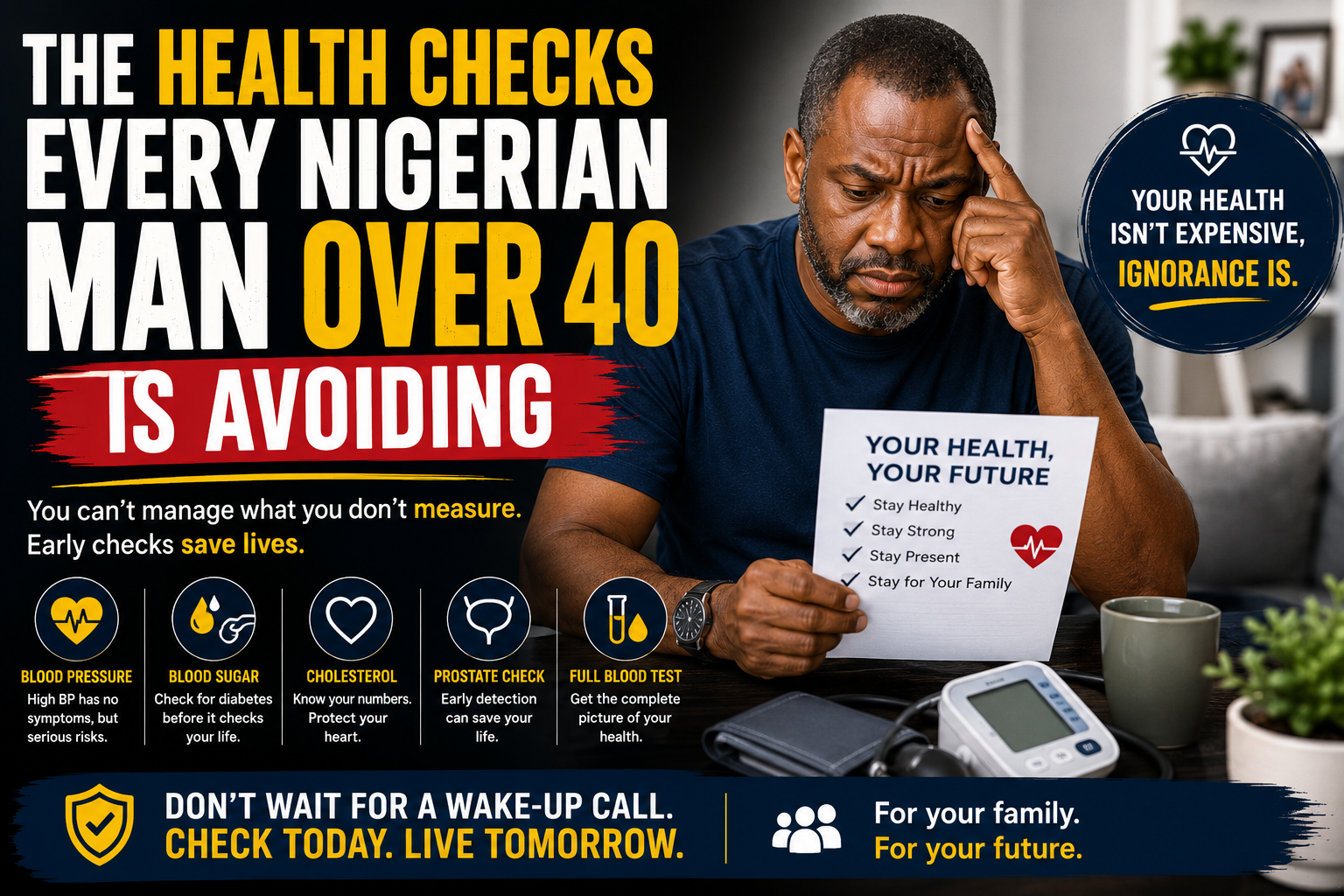
Nigerian men do not go to hospital.
Not from stupidity — from a set of reasons that are entirely understandable and collectively lethal. There is no time. There is no money. There is nothing wrong. And underneath all of it, the quiet reasoning that if you do not check, there is nothing to find.
The result is a pattern anyone in a Nigerian family will recognise: a man who was fine on Tuesday has a stroke on Thursday, and the family discovers he had been hypertensive for a decade.
Almost every condition on this list is manageable when caught early and devastating when caught late. The difference is usually one appointment.
Why men avoid it, honestly
“I feel fine.” The most dangerous sentence in this article. Hypertension, high cholesterol, early diabetes, and early prostate cancer produce no symptoms in the stages where treatment works best. By the time you feel something, you have missed the window.
The fear of finding out. Rarely admitted and very common. There is a sense that not knowing is safer, or that a diagnosis will define you.
Cost and time. Real constraints, and worth weighing against what a stroke costs — in hospital bills, in lost earning years, in what your family carries afterwards.
“Prayer is my covering.” Held sincerely by many. But taking medicine is not doubt, and neither is a blood test. Luke was a physician. The question is not whether God can heal; it is whether you are willing to be told what is wrong.
Provider syndrome. The man who has funded everyone else’s hospital bills and never spent anything on himself. This is presented as sacrifice. It is more accurately a plan to leave your family without you.
The checks that matter most
1. Blood pressure — the highest priority on this list
Hypertension is called the silent killer for an accurate reason: it usually produces no symptoms at all until it causes a stroke or a heart attack.
Nigerian men are highly susceptible — a combination of genetic factors, salt intake, urban stress, traffic, and financial pressure.
How often: WHO guidance suggests adults check at least every two years, and more frequently with risk factors or family history. In practice, if you are a Nigerian man over 40, check it far more often than that — every few months. It costs almost nothing and pharmacies and clinics everywhere will do it.
What matters: a single elevated reading does not mean hypertension. Diagnosis requires confirmed elevation across multiple readings or a clear upward trend. Which is exactly why one reading is not enough and repeated checks are.
Buy a home monitor. They are inexpensive, and a man who checks weekly at home will catch a change months before an annual appointment would.
2. Blood sugar
Type 2 diabetes is rising sharply in Nigeria and, like hypertension, is largely symptomless in early stages. Untreated it damages kidneys, eyes, nerves, and cardiovascular health.
The test is a fasting blood glucose, or an HbA1c which reflects the average over roughly three months. Both are simple blood draws.
How often: at least annually from 40, more frequently with a family history, excess weight, or an existing hypertension diagnosis.
Prediabetes is reversible. That is the entire argument for testing. Caught at that stage, diet and activity changes frequently prevent progression completely.
3. Prostate — the contested one, handled honestly
Prostate cancer is the most common cancer among Nigerian men, and men of African descent present with more advanced disease at earlier ages than several other groups.
Community screening research in Lagos found that among men over 40 who were diagnosed, only about a quarter had disease still confined to the prostate — around 40% were locally advanced and roughly a third had already spread. In other words, Nigerian men are overwhelmingly being diagnosed late.
The tests are a PSA blood test and a digital rectal examination. They are usually used together, because each catches things the other misses.
Here is where you should know the guidance genuinely differs. The American Urological Association and American Cancer Society recommend screening from 50 generally, and from 40–45 for higher-risk men — a category that includes men of African descent and those with an affected close relative. Meanwhile, the US Preventive Services Task Force does not recommend population-level PSA screening, and frames it for men 55–69 as a shared decision with a doctor after discussing benefits and harms.
Why the disagreement: PSA is imperfect. Elevated levels can result from an enlarged prostate or inflammation rather than cancer, which leads to biopsies and treatment for conditions that would never have caused harm.
What this means for you practically: do not skip it, and do not treat it as a simple annual tick-box either. Have the conversation with a doctor from 40, given that African ancestry places you in the higher-risk group, and decide together. If you have a father or brother who had prostate cancer, that conversation is more urgent.
Symptoms that mean see someone now, regardless of age or screening views: frequent urination especially at night, a weakening or interrupted urine flow, difficulty starting, or blood in urine or semen.
4. Cholesterol
A lipid profile — a blood test measuring cholesterol and triglycerides. Elevated levels are symptomless and a major contributor to heart attack and stroke risk.
How often: every four to six years is standard guidance, considerably more frequently with obesity, hypertension, diabetes, or a family history of heart disease.
5. Hepatitis B and C
Both are common in Nigeria, both can cause chronic liver damage and liver cancer, and both can run for years without symptoms until the damage is irreversible.
The test is a simple blood screen. Hepatitis B is vaccine-preventable, and hepatitis C is now curable with treatment in most cases — which makes not knowing your status particularly costly.
Do this once if you have never done it. Then follow medical advice on repeats.
6. Eyes and teeth
Unglamorous and consistently neglected.
Glaucoma is a leading cause of irreversible blindness, more common in people of African descent, and painless until vision is already lost. An eye examination from 40 catches it while treatment still preserves sight.
Dental infections are linked to cardiovascular problems and are far cheaper treated early.
7. Weight, waist and sleep
Waist measurement predicts metabolic risk better than weight alone. Abdominal fat is the concerning kind.
Sleep — if you snore heavily, stop breathing during sleep, or wake exhausted regardless of hours, ask about sleep apnoea. Untreated it is linked to hypertension, cardiovascular disease, and worsening diabetes.
8. Mental health
Nigerian men do not discuss this, which is why it belongs on a list of things being avoided.
Persistent low mood, loss of interest, irritability, sleeplessness, or an inability to cope that does not lift is a medical matter, not a character weakness or a spiritual failure. It is common, and it is treatable.
A realistic plan
This month: get your blood pressure checked. Buy a home monitor. That single step addresses the highest-probability threat on this list.
This quarter: book one appointment covering fasting blood glucose, a lipid profile, and hepatitis B and C screening. One blood draw covers most of it.
From 40: have the prostate conversation with a doctor. Decide together on an approach and stick to it.
Annually thereafter: blood pressure, blood sugar, weight and waist, plus whatever your doctor recommends for your specific risk profile.
Check whether you are already covered. If you work somewhere with five or more employees, health insurance is now legally mandatory in Nigeria and you may have cover you are not using. Many HMO plans include an annual health check at no additional cost.
What to say to the man in your life
Wives, sisters, and adult children are usually the ones who get a Nigerian man to a clinic.
What tends not to work: nagging, fear, statistics.
What tends to work: booking the appointment yourself and telling him the date. Going with him. And framing it around the people who depend on him rather than around him — because a man who will not spend two hours on his own health will frequently do it for his children.
One sentence that lands: “Your father’s family history is now yours to manage. The children need you at seventy.”
The thing worth understanding
None of this is about living forever.
It is about the difference between a manageable condition found at 44 and a catastrophic one found at 52 — between tablets and a stroke, between a treatable cancer and one that has already spread.
Your family does not need you to be strong. It needs you to be present at seventy.
Get your blood pressure checked this week. It takes ten minutes.
This article is general information, not medical advice, and screening guidance genuinely differs between medical bodies. Discuss your own risk factors and screening decisions with a qualified doctor.