

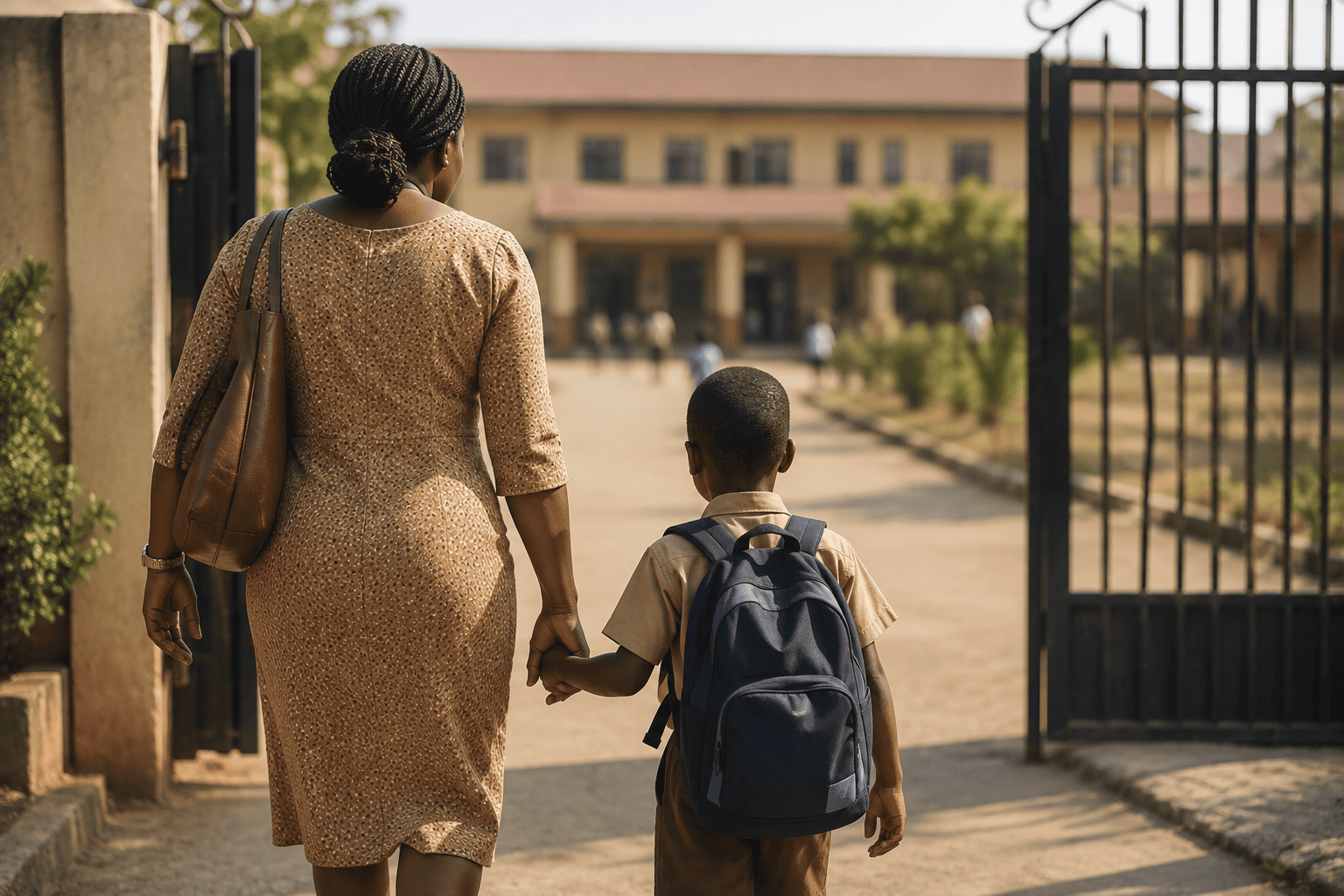
Most parents choose a school on three things: the building, the fees, and what other parents say about it.
None of the three predicts much.
The building tells you what the school spent on marketing itself. The fees tell you what the school believes it can charge in that area. And other parents are, understandably, defending the decision they already made.
Meanwhile the things that actually determine whether your child thrives are largely invisible on a school tour, and nobody volunteers them.
Here is what to look at instead, and how to find it out.
Start with the question you have not asked
Before comparing schools, answer this: what is this child specifically like?
Not children in general. This one.
Do they crumble under pressure or rise to it? Are they socially confident or do they need a small setting to open up? Do they have a subject that lights them up? Do they have a difficulty — reading, attention, anxiety — that a rigid school would make worse?
The best school in the city is the wrong school for a child it does not suit. A quiet, anxious child in a highly competitive academic environment will not be sharpened by it; they will be diminished. A restless, physical child in a school with no sport and long sitting hours will be labelled a problem for six years.
Most bad school choices are not choices of bad schools. They are mismatches.
What actually predicts outcomes
1. Teacher quality and teacher turnover
The single most important factor, and the least discussed.
A good teacher in a modest building outperforms a poor teacher in an excellent one, every time. What you want to know is not whether the teachers are qualified — most will be, on paper — but whether they stay.
Ask directly: How many teachers left at the end of last academic year? How long has my child’s likely class teacher been here?
High turnover is the clearest warning sign in education. It usually means teachers are underpaid, poorly managed, or unsupported, and it means your child will be taught by a succession of people still learning the school. A school where teachers stay five, eight, ten years is telling you something no brochure can.
2. Class size, and what actually happens in the room
Class size matters, but less than what happens within it. A class of thirty with an engaged teacher beats a class of fifteen with a disengaged one.
Ask to observe a lesson. Not a staged one — an ordinary lesson, unannounced if they will permit it. A school that refuses entirely is telling you something.
What to look for: Are children talking and asking questions, or copying silently? Does the teacher know their names? What happens when a child gets something wrong — is it corrected without humiliation? Are the children at the back engaged or invisible?
3. How the school handles the struggling child
Every school performs well with the child who is already thriving. The test is what happens to the one who is not.
Ask: What do you do when a child falls behind? Who notices, and how quickly? What support exists?
Watch for schools that answer this by describing what they do to the child rather than for them. If the entire answer is about discipline and consequences, you have your information.
Ask about children with learning differences. Even if yours has none identified, a school’s answer tells you about its whole philosophy. Schools that quietly push out children who are difficult to teach reveal it in this answer.
4. Discipline philosophy
This matters enormously in the Nigerian context and it is worth being direct about.
Ask plainly: Is corporal punishment used here? By whom, for what, and who authorises it?
Ask the question of the head, and then ask a current parent separately, because official policy and daily practice diverge frequently. If the answers differ, believe the parent.
Whatever your own view on discipline, you should know what will actually happen to your child, and you should have consented to it rather than discovered it.
Also ask how bullying is handled. The answer “we do not have bullying here” is never true and tells you the school does not look.
5. Results, read properly
Examination results are the most cited metric and the most misleading, because a school that admits only strong students and removes weak ones before external exams will post excellent numbers while adding very little.
The useful questions: What proportion of the students who started here in year one sat the final exams here? Do you require a minimum grade to progress to the exam year?
Schools that filter heavily will be uncomfortable answering. That discomfort is the information.
6. Distance and the daily reality
Chronically underweighted, and it compounds daily for years.
A child leaving home at 5:30am and returning at 6pm in Lagos traffic is losing sleep, family time, and homework capacity every single day. Over six years the cumulative cost frequently exceeds whatever academic advantage the distant school offered.
Be realistic about the actual commute at the actual times, not the theoretical distance.
7. Values and environment
You will be handing over roughly a third of your child’s waking hours, during the years their character is forming.
For faith-based schools specifically: ask what the religious content actually looks like day to day, and whether it is formative or performative. Some Christian schools have a genuine ethos. Others have a name and an assembly.
More broadly: what does the school celebrate? A school that only ever praises academic results is shaping children to believe that is what makes them valuable. Look at what is on the walls, what is announced, and what gets rewarded.
What matters far less than you think
The building. New facilities are pleasant and predict very little. Some of the strongest schools operate in modest premises with excellent teaching.
Technology. A tablet for every child is a marketing feature, not an educational one. Evidence on classroom technology improving outcomes is considerably weaker than the sales pitch suggests.
The curriculum label. British, American, Nigerian, IB — parents agonise over this and it matters less than execution. A well-taught Nigerian curriculum beats a badly delivered British one, and the badly delivered British one costs three times as much.
Prestige and reputation. Reputations lag reality by years. Schools decline after a good head leaves, and improve quietly under a new one, long before the reputation catches up.
Uniform and appearance. A well-presented school is not necessarily a well-run one. Smartness is easy to produce and easy to mistake for rigour.
How to actually investigate a school
Visit on an ordinary day, not an open day. Open days are performances. Ask to come on a regular Tuesday.
Talk to parents who left. The most valuable people you can find, and the hardest. Ask the school for a parent contact, then find one independently — anyone can produce a satisfied parent on request.
Talk to a teacher, not just the head. Ask how long they have been there and what they would change. Teachers are often more candid than administrators.
Look at the toilets. Not a joke. Facilities that children use and adults do not inspect tell you what a school does when nobody is watching.
Watch break time. Are children playing? Is anyone alone? How do staff interact with them when there is no lesson to deliver?
Ask your child afterwards. Older children in particular pick up things you will miss.
The fees question
Two honest points.
More expensive is not reliably better. Fees track location, facilities, and market positioning far more than teaching quality. There are excellent mid-fee schools and poor expensive ones.
Do not commit to fees you cannot sustain for the full run. The most damaging school-related decision Nigerian families make is entering a school whose fees they can only just meet, then facing arrears, then withdrawing the child mid-run. Disruption of that kind costs more academically than starting at a slightly less prestigious school and staying.
Calculate the full term including the years when fees rise, and add the extras — uniform, books, trips, exam fees, transport — which routinely add 20–30% to the headline figure.
If you get it wrong
You might, and it is recoverable.
Signs worth acting on: a child who was happy and is now reluctant to go, a marked drop in confidence, a teacher who cannot tell you anything specific about your child, repeated dismissal of concerns you raise.
Give it a term to settle — most children struggle initially with any change. But do not spend three years hoping a bad fit will resolve itself. Children adapt to a school change far better than parents expect, and far better than they adapt to six years in the wrong place.
The short version
Ask about teacher turnover. Observe an ordinary lesson. Find out what happens to the child who falls behind. Ask directly about discipline. Check whether results are produced by teaching or by filtering. Be honest about the commute. And start from what this particular child needs rather than from what school is considered best.
That will tell you more in one visit than a year of asking other parents.