

The call usually comes on an ordinary weekday.
Your mother has had a fall. Your father’s blood pressure has been dangerously high for weeks and nobody told you. The person who has always been the strong one in the family cannot manage the stairs anymore.
And in the space of that phone call, a set of obligations arrives that nobody prepared you for — obligations that will run for years, cost more than you expect, and quietly compete with your marriage, your children, and your own health.
Almost every family handles this badly the first time. Not from lack of love. From lack of planning.
The honest framing
Two things are true at once, and most advice on this subject picks one and ignores the other.
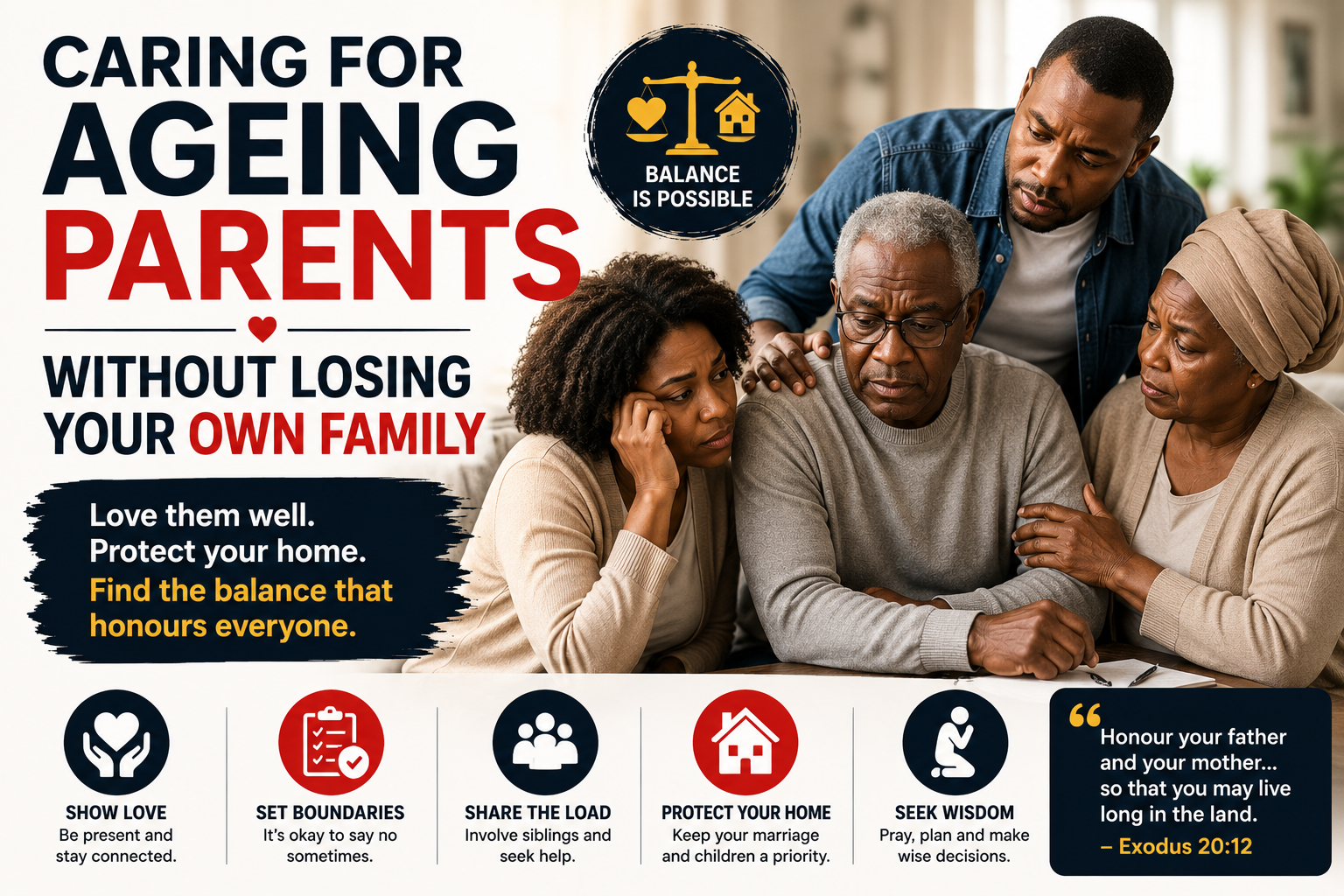
Honouring your parents is not optional. It is a commandment, it carries no expiry at eighteen, and 1 Timothy is explicit that providing for relatives is a matter of faith itself. Nigerian culture reinforces this powerfully, and rightly.
And you have a household of your own that is also your responsibility. The same passage that commands providing for relatives specifies “especially those of his own household.” A person who destroys their marriage, their children’s future, and their own health caring for a parent has not fulfilled the obligation — they have transferred the crisis one generation forward.
The task is not choosing between them. It is building something sustainable enough to do both for a decade.
Have the conversation before the crisis
The single highest-value thing in this article, and the one almost nobody does.
Most families have their first serious conversation about ageing parents during an emergency — in a hospital corridor, with siblings arriving from different cities, everyone frightened and nobody having any information.
What to establish while your parents are still well:
Their medical picture. What conditions do they have? What medication, at what dose? Which doctor and which hospital? Are they insured, and with whom?
Their finances. Is there a pension? Savings? Income from property? What do their monthly costs actually look like? Many adult children have no idea and discover it during a crisis.
Their documents. Where are the property papers, the certificates, the bank details? Is there a will? This is the same location list that solves so much else.
Their wishes. Where do they want to live as they age? What are their views on medical intervention? Would they accept a carer in the house? Would they consider moving in with a child?
How to raise it: attach it to something external rather than to their decline. “A friend’s father had a fall last month and the family didn’t know which hospital he used. It made me realise we’ve never talked about any of this. Can we write it down?”
Ask for the information first, not for decisions. It is far less confronting and it delivers most of the practical value.
The sibling conversation
Where most of the resentment lives.
The default pattern in Nigerian families: one child — usually the one who lives closest, and very often a daughter — absorbs everything. The others contribute occasionally, appear at crises, and offer opinions about decisions they are not present for.
That arrangement holds for a while and then destroys the sibling relationships permanently.
Have the conversation explicitly, and early. Not during a crisis. Set up a call with all siblings and put the actual questions on the table:
- Who provides the day-to-day presence — visits, appointments, checking in?
- Who contributes money, and how much, proportionate to means?
- Who handles administration — insurance, documents, hospital arrangements?
- What happens when a decision must be made quickly? Who decides?
The principle that keeps it fair: those who cannot give time should give money, and those who cannot give money should give time. A sibling abroad who cannot visit can fund the carer. A sibling nearby with limited income can provide the presence.
And the person doing the daily care should be receiving something. This is rarely discussed and it matters enormously. The daughter who has taken over her parents’ care is losing income, career progression, and years. Treating that as free because she is nearby is unjust, and it is the single biggest driver of lasting sibling bitterness.
Protecting your own household
Tell your spouse everything, as it happens. Care obligations handled unilaterally are one of the most common sources of serious marital conflict in this situation — particularly where money moves without discussion, and particularly where it is the in-laws.
Set a monthly amount together. Same structure that works for family support generally: an agreed figure, sent on a set date, rather than a fresh negotiation at each crisis. Hold a separate small reserve for genuine medical emergencies.
Protect specific things absolutely. Your children’s education. Your own retirement savings. Your health. If care costs are consuming these, the arrangement needs restructuring, not more sacrifice.
Do not let it consume every conversation. Couples in this season report that their entire relationship becomes logistics about a parent. Protect one recurring slot where the topic is off-limits.
Watch your own health. Carer burnout is real and it presents as exhaustion, irritability, and low mood. A carer who collapses helps nobody. If you are the primary carer, you need scheduled time off — genuinely off, with someone else covering.
The practical options in Nigeria
Parents living independently with support. Usually the best outcome where possible. A daily or live-in house help, regular family visits, a neighbour who checks in, and a phone they can actually use. Far cheaper and better for their dignity than the alternatives.
Moving in with a child. Common, and it works when discussed properly and fails when assumed. If you are considering it, settle in advance: which room, what privacy each household retains, who handles their medical decisions, and — critically — whether your spouse genuinely agrees rather than merely consenting.
A hired carer. Increasingly available in Nigerian cities. Verify references properly, and be aware that a carer with unsupervised access to a vulnerable person requires real diligence. Rotate visits so someone from the family sees the situation unannounced.
Domestic staff already in the household often become the de facto carers. If so, recognise it, train them for it, and pay accordingly.
Residential care remains uncommon and often culturally difficult in Nigeria, though options are emerging in major cities. If a parent’s needs exceed what a household can safely provide — advanced dementia, for instance — this is worth investigating without shame.
If you are abroad: the most useful things you can fund are a reliable carer, health insurance, and a smartphone with data so you can actually see them. Money sent without any local structure frequently does not translate into care.
The money, realistically
Budget for these:
- Medication, often monthly and often for multiple chronic conditions
- Doctor visits and periodic tests
- A carer or increased domestic help
- Home modifications — handrails, better lighting, a ground-floor sleeping arrangement
- Transport to appointments
- Emergency admissions, which are the largest and least predictable item
Check what already exists. Does either parent have a pension? Any health insurance? Are they eligible for a state health scheme? Many older Nigerians have entitlements nobody has ever claimed.
Health insurance for parents is worth investigating even at older ages. Some HMOs cover older enrolees, and a monthly premium is far more manageable than an unpredictable series of emergency bills — particularly if you are the family’s de facto emergency fund.
The parts that are hardest
Role reversal. Instructing the person who raised you, taking their car keys, managing their money. It is disorienting for you and humiliating for them. Preserve their decision-making wherever it is safe to do so, and involve them in every choice they can still participate in.
A difficult parent. Not every ageing parent is easy, and some were not good parents. Honouring a parent does not require pretending the past did not happen, and it does not require unlimited access to your household. You can ensure someone is cared for without being their primary carer. If this is your situation, talk to someone — it carries a particular kind of guilt that is worth naming out loud.
Dementia. If a parent’s memory or personality is changing, get a medical assessment early. Some causes are treatable. And carers of people with dementia need support structures rather than willpower.
Grief that starts before the death. Watching a parent decline is a form of bereavement that arrives years early and gets no recognition. It is real, and it is worth telling someone about.
Where to start this month
One conversation with your parents — information only. What conditions, what medication, which doctor, where the documents are, what they want.
One conversation with your siblings — who does what, who pays what, written down.
One conversation with your spouse — the monthly amount, the emergency reserve, and what you are protecting no matter what.
One page written down — their medical details, their documents’ location, their insurance, emergency contacts.
None of it takes long. All of it is far easier now than in a hospital corridor at midnight with everyone frightened and nobody informed.
General guidance, not medical or financial advice. For decisions about a parent’s care or health, consult qualified professionals familiar with their circumstances.