

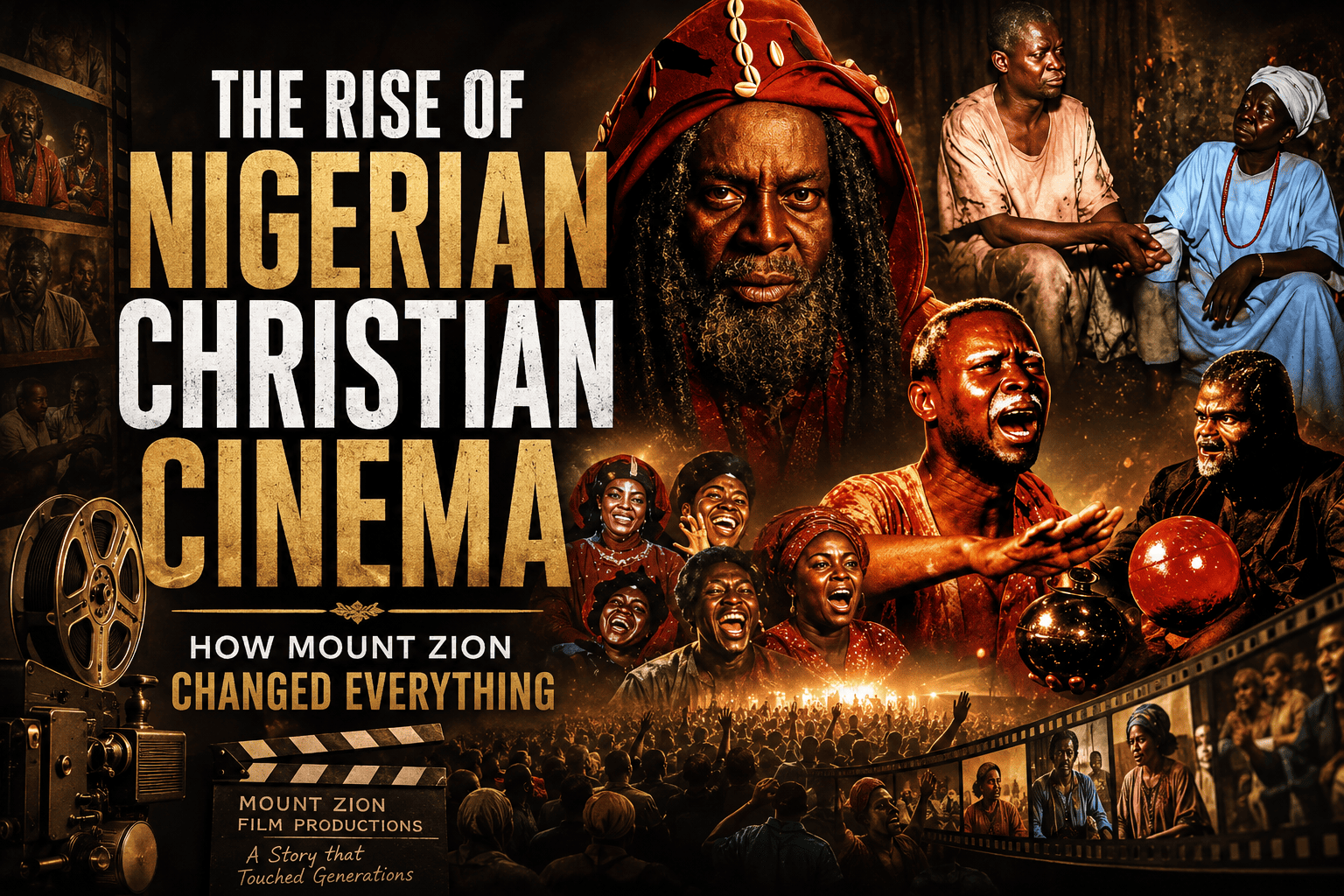
In 1985, three students at a college in Ilesha decided to start a drama ministry.
There was no film industry in Nigeria to speak of. Nollywood as we know it would not begin for another seven years. There was no equipment, no funding, no distribution, and no template — nobody in the country was making Christian films because nobody in the country was making films.
Four decades later, that ministry has produced more than 200 films, trained thousands of filmmakers, and this October will place a title in Nigerian cinemas nationwide.
The story of Nigerian Christian cinema is very largely the story of Mount Zion, and it is worth telling properly.
The beginning: stage before screen
Mount Zion Faith Ministries was founded on 5 August 1985 in Ibadan by Mike Bamiloye and Gloria Obembe — later Gloria Bamiloye — along with Grace Adeyemi. The founders were students, or recent students, of the College of Education in Ilesha, Osun State.
The first year was not spent making anything. It was spent in prayer, fasting, and study, preparing for something none of them could yet describe.
The first public output came on 11 July 1986: a musical theatrical presentation titled Hell In Conference, staged at St. Margaret Girls’ Grammar School in Ilesha during the first Nigerian Christian Teachers Conference.
In August 1987, Mike Bamiloye resigned from teaching to work on the ministry full time. He and Gloria married in October 1988. By August 1989, the entire membership had gone into full-time service.
This detail matters for understanding everything that followed. Mount Zion did not begin as a production company that acquired a religious mission. It began as a mission that acquired a camera.
The first film, and the leap to screen
The first Mount Zion film was The Unprofitable Servant, produced and directed by Mike Bamiloye in 1990.
That timing is significant. Living in Bondage, conventionally treated as the beginning of Nollywood, arrived in 1992. Mount Zion was making films on video before the industry it would later be measured against existed.
Then came 1993, and Agbara Nla.
Why Agbara Nla broke through
Agbara Nla — released in English the following year as The Ultimate Power — did something no Nigerian production had attempted at that scale: it put the spiritual realm on screen in the visual and moral vocabulary its audience already used.
Occult covenants. Village shrines. Marine spirits. Herbalists. Demonic strongholds. And against all of it, prayer, faith, and confrontation.
For a Western viewer this reads as genre. For the Nigerian Christian audience of 1993 it read as documentary. These were the categories through which people already understood illness, misfortune, family conflict, and success. Agbara Nla did not invent a world; it dramatised the one its viewers believed they were living in, and then showed something overcoming it.
The response was not primarily commercial. Viewers reported conversions, deliverances, and revivals traced to watching it. Copies circulated through churches, schools, and neighbourhoods on tapes that were watched until they degraded.
Mount Zion has produced over 200 films since. None has displaced it in public memory.
The distribution model nobody else could copy
The reason Mount Zion’s reach so vastly exceeded its budget was a distribution system that had nothing to do with cinemas or television networks.
Films went out on VHS, then VCD, then DVD, through church bookshops, ministry outreaches, and hand-to-hand copying that nobody attempted to police. Live drama tours took the ministry across Nigeria — Kano, Zaria, Kaduna, Jos, Calabar, Benin, Warri — then into Ghana, Cameroon and Kenya, and in 2003, to London.
From 2003, the ministry describes film and television serial production becoming a priority vision rather than one activity among several.
The model had an obvious weakness: almost no revenue. It also had a strength that commercial Nollywood could not match. A Mount Zion film reached the interior of the country and the diaspora simultaneously, through networks of trust rather than networks of sale. People did not encounter these films as products. They encountered them as something a pastor, a mother, or a friend put in their hands.
The training pipeline
The part of the Mount Zion story most often overlooked is the school.
The Mount Zion Institute of Christian Drama, based in Ile-Ife, was established in 1991 and has trained more than four thousand students. Its alumni fellowship now has members in some sixty nations.
This is the difference between a successful production house and a movement. One makes films; the other makes filmmakers. A significant proportion of the people making Christian film in Nigeria and across Africa today passed through that pipeline, and the aesthetic and theological instincts of the whole sector bear its fingerprints.
Mike Bamiloye also chairs the board of ANCEDRAM, the association of Nigerian drama and film ministries — another piece of the same infrastructure-building instinct.
The second generation, and the YouTube shift
The most consequential recent development has been the arrival of the Bamiloye children as filmmakers in their own right.
Damilola Mike-Bamiloye, born in 1989, trained at Bowen University and then in film production and editing. He began in his teens under his father’s mentorship and is now credited with substantially raising Mount Zion’s technical standard — cinematography, editing, and pacing that could stand beside mainstream Nollywood.
His breakout was the Abattoir series, which premiered on YouTube and drew millions of views. Other titles include The Train, a biographical film about his father and the founding of the gospel film industry in Nigeria, along with Legion, 30 Pieces, Gbemi, and Shackles. He was director of photography on the House on Fire and Abejoye series.
Joshua Mike-Bamiloye, known as JayMikee, has built a parallel presence in gospel music and film.
The YouTube shift did something the VHS era could not: it made the audience measurable. A view count is evidence. For the first time, Christian filmmakers in Nigeria could demonstrate demand in numbers a distributor or advertiser would recognise.
The problem the industry has never solved
For all of that reach, Christian film in Nigeria has never solved its economics.
The model has been ministry, not industry — funded by churches and donations, distributed free or near-free, and staffed substantially by people working for little or nothing. It has been evaluated by souls rather than by revenue.
That produced enormous impact and almost no sustainability. Talented Christian filmmakers have consistently faced a choice between working without pay and working in secular Nollywood. Production budgets have stayed small because there was no mechanism to recover them. And thirty years of free distribution trained an audience to expect faith content at no cost — which makes charging for it later extremely difficult.
This is the genuine constraint on the sector. Not talent, and no longer technical skill.
Why October 2026 matters
Agbara Nla: The Return opens in Nigerian cinemas nationwide on 1 October 2026, co-directed by Damilola and Joshua Mike-Bamiloye, produced in collaboration with Sozo Films and the Circuits platform, with Mike Bamiloye returning as Isawuru.
The nostalgia is the headline. The business model is the real story.
A theatrical release means paid tickets, competition for screen time against secular releases, and a public box office figure. It is an attempt to prove that a Christian film can fund the next Christian film — that the sector can operate as an industry without ceasing to be a ministry.
If it works, it changes what is possible for a generation of faith-based filmmakers across the continent. If it does not, the free-distribution model remains the only viable one, with all the limits that implies.
What the last forty years actually demonstrated
Strip away the specifics and Mount Zion’s story makes a fairly simple argument.
A group of people with no money, no equipment, and no industry to join built a distribution network out of church halls, a training institution out of nothing, and a body of work that shaped how millions of Africans imagine the spiritual world — before Nollywood existed, and largely without its help.
The technical quality has risen enormously. The audience has moved from tapes to YouTube to cinema screens. The founders’ children now hold the cameras.
What has not changed is the founding conviction: that the stories a culture tells itself are worth contesting, and that film is where that contest happens.