
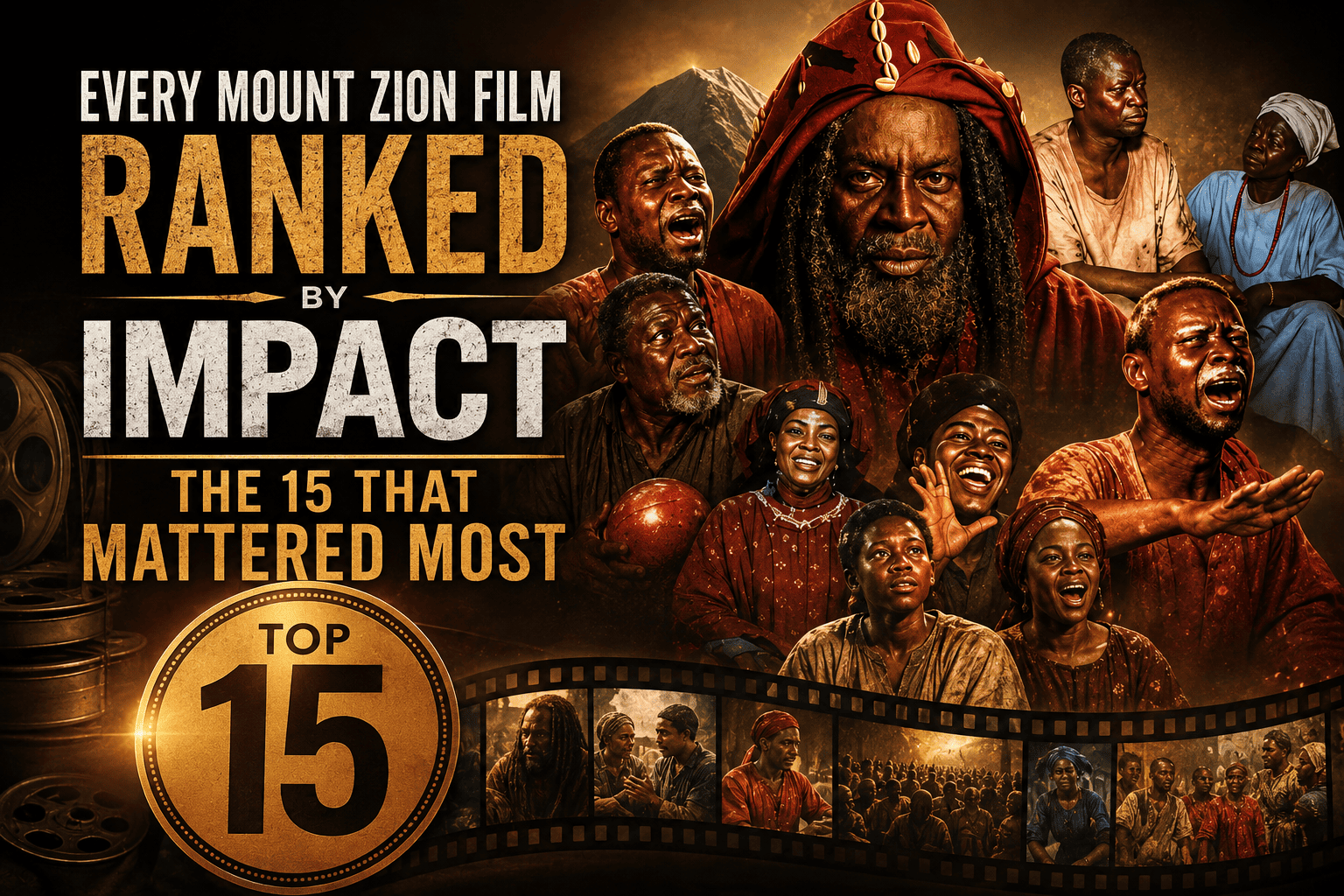
Mount Zion Film Productions has released more than 200 films since 1990. Ranking all of them is not possible in any honest way — there is no box office data, no complete viewership record, and no archive that captures how a VHS tape circulated through a church in 1996.
What can be done is to rank the ones whose impact is documented, remembered, or measurable. That is what this list does.
How impact was judged: cultural penetration (do people who did not seek the film out still know it?), influence on the ministry’s direction, technical or commercial firsts, and measurable reach where figures exist. Not artistic quality, and not personal preference.
1. Agbara Nla / The Ultimate Power (1993)
Nothing else comes close.
Written and directed by Mike Bamiloye, released in Yoruba in 1993 with an English version the following year, it put spiritual warfare on screen in the exact vocabulary its audience used to understand their own lives — occult covenants, village shrines, marine spirits, the herbalist Isawuru, the agent Ayamatanga.
The response was not primarily commercial. Viewers reported conversions, deliverances, and community revivals traced back to watching it. Tapes circulated until they wore out.
Thirty-three years later it is the film returning to cinemas nationwide on 1 October 2026, and the only Mount Zion title a general Nigerian audience can name without prompting.
2. Ide Esu (The Devil’s Bondage)
If Agbara Nla defined spiritual warfare, Ide Esu defined the money ritual film.
The story of two friends who turn to blood money to escape hardship, and discover what the devil’s gifts actually cost, reached almost every Christian household in Nigeria. It is consistently named first or second in any list of remembered Mount Zion titles, and its treatment of ritual wealth shaped how a generation understood sudden, unexplained prosperity.
3. The Unprofitable Servant (1990)
The first film Mount Zion ever made, produced and directed by Mike Bamiloye.
It ranks here on significance rather than reach. This was the leap from stage drama to screen — made two years before Living in Bondage, the film conventionally credited with beginning Nollywood. Everything that followed depended on someone deciding this was possible.
4. Abejoye (2018– )
Written by Mike Bamiloye, who also takes the lead role, and running across seven seasons.
Abejoye proved Mount Zion could hold a modern audience across a long-form serial. Each release drew substantial view counts, and its focus on family, purpose, and stewardship broadened the ministry’s range well beyond spiritual warfare. It is the title that demonstrated the YouTube era could work for them.
5. Abattoir (2019– )
Damilola Mike-Bamiloye’s breakout as a director, running to four seasons and premiering on YouTube to millions of views.
Its significance is technical as much as narrative. Abattoir is where Mount Zion’s production standard — cinematography, editing, pacing — visibly caught up with mainstream Nollywood. It is the film that answered the long-standing charge that Christian film in Nigeria could not look good.
6. One Careless Night
The cautionary film about sexual sin that a generation of Nigerian youth fellowships screened, discussed, and quoted.
Whatever one makes of its approach, few films have been used more systematically as a teaching tool. Its impact was institutional: it entered the standard repertoire of church youth ministry across the country.
7. The Train (2020)
Damilola Mike-Bamiloye’s biopic of his father and the founding of the gospel film industry in Nigeria.
It matters because it made the ministry’s own history into narrative — the story of how a teacher resigned his job in 1987 to do something that did not yet exist. For younger viewers who arrived via YouTube, this is where the origin becomes visible.
8. Enoch (2023)
The biographical film that drew over 3.3 million views in eight months.
That figure is one of the few hard numbers available anywhere in this catalogue, and it demonstrated something important: the second generation could reach a large audience with new material, not only with legacy titles.
9. House on Fire (parts 1–7)
A long-running serial, with Damilola Mike-Bamiloye as director of photography, that helped establish the multi-part format Mount Zion now uses routinely.
Its subject — the interior collapse of a Christian household — moved the ministry into domestic drama, a register it has returned to consistently since.
10. Perilous Times
An end-times film that landed in a period when eschatological anxiety was running high in Nigerian churches.
It belongs on any serious list because it captured a specific spiritual mood of its era, and because the end-times genre it helped establish remains a staple of African Christian film.
11. The Beginning of the End
Another of the titles Mount Zion itself lists among its most notable works, and part of the same eschatological cluster.
Its durability is the point: it is still named decades later in lists compiled by people who watched it as children.
12. Legion
Written, produced, and directed by Damilola Mike-Bamiloye.
A demonstration of the second generation handling the ministry’s core subject — spiritual confrontation — with contemporary technique rather than inherited style.
13. 30 Pieces
Also from Damilola Mike-Bamiloye, and one of the titles that established him as a writer-director rather than only a technician.
The betrayal framing gave the ministry a way into moral complexity that its earlier work, with its clearer lines between light and darkness, tended to avoid.
14. Shackles (2019)
A Mike Bamiloye title from the period when the ministry was actively transitioning to online distribution, and a useful marker of how the older and newer approaches sat alongside each other.
15. Captives of the Mighty
Frequently named among the titles that shaped childhoods, particularly for its treatment of spiritual bondage and deliverance.
Its presence in nostalgia lists decades later is itself the evidence of impact.
What this list cannot capture
Several things are missing, and it is worth saying so.
The stage years. Before any film existed, Mount Zion toured live drama across Nigeria, Ghana, Cameroon, and Kenya, and reached London in 2003. Hell In Conference, staged in Ilesha in 1986, was the actual beginning. None of that appears in a film ranking.
The Institute. The Mount Zion Institute of Christian Drama, founded in 1991, has trained more than four thousand students with alumni in around sixty nations. The most significant output of this ministry may not be any film at all, but the filmmakers.
The small ones. Dozens of titles reached specific communities intensely and left no public record. Somebody’s conversion is attached to a film nobody has written about.
The pattern the ranking reveals
Read top to bottom, the list traces a clear arc.
The early period is spiritual warfare and moral consequence, made with almost no resources, distributed free, and enormously effective at reaching people the formal industry could not touch.
The recent period is technically sophisticated, YouTube-native, measurable, and increasingly interested in domestic and psychological terrain rather than only the shrine.
What connects them is a founding conviction that has not shifted in forty years: that the stories a culture tells itself are worth contesting, and that film is where the contest happens.
The cinema release this October is the next test of that conviction — and the first one where the audience is being asked to pay.