
If you spend any time in Nigerian Christian spaces online, you have encountered him — whether or not you know the name.
The clips circulate constantly: a preacher in full flow, the phrase Olorun Ojiji recurring, congregations with hands open, prayer sessions that run long. On TikTok alone, content associated with his ministry runs into hundreds of thousands of posts.
He is one of the most visible Nigerian pastors of the social media era, and also one of the least documented. There is enormous footage and very little biography.
Here is what is actually established.
The basics
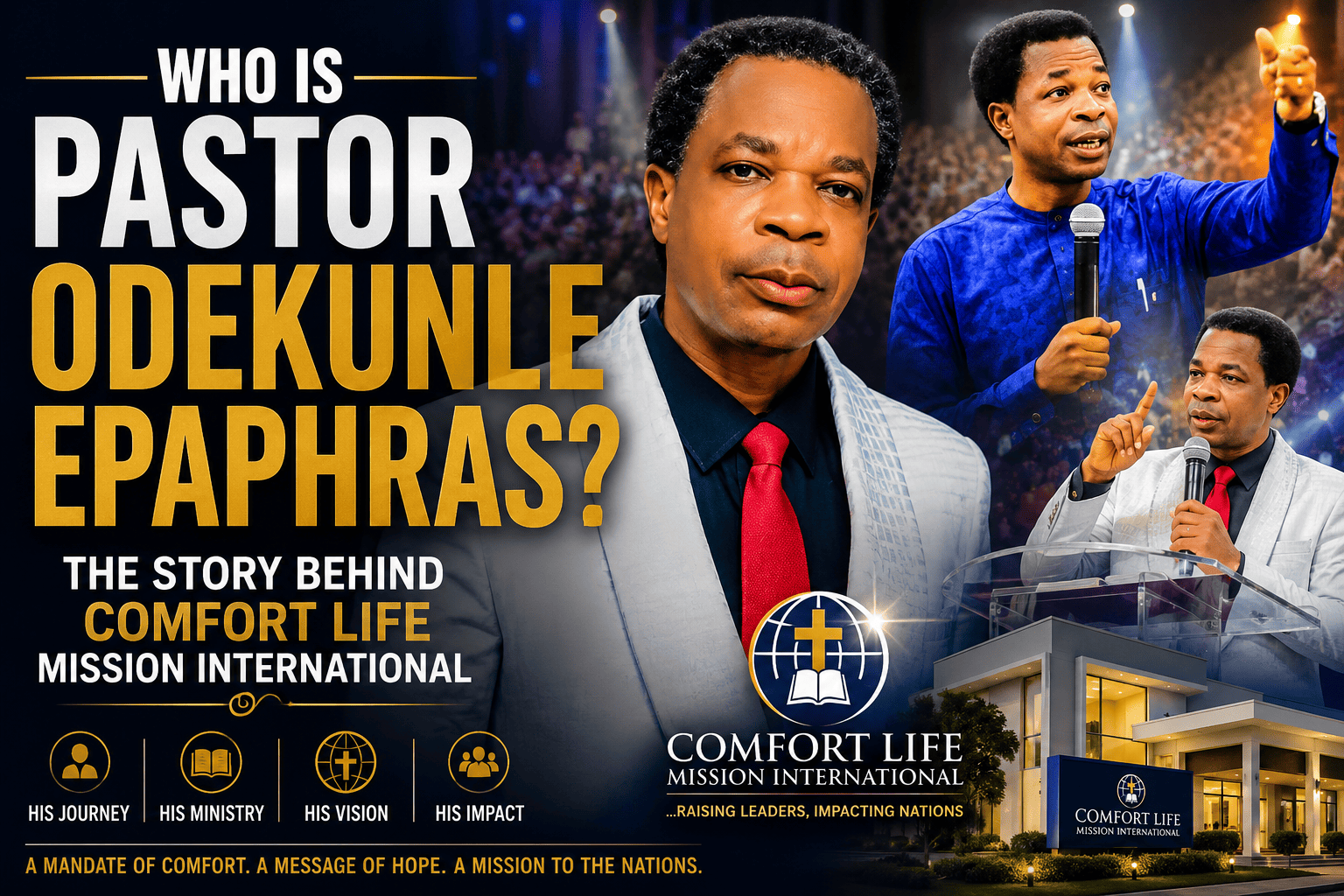
Name: Prophet Odekunle Epaphras Ministry: Founder and General Overseer, Comfort Life Mission International Base: Ibadan, Oyo State Also known for: the Olorun Ojiji messages and a regular Saturday morning broadcast Status: married; his wife ministers alongside him and is referred to within the church as Pastor Mrs Odekunle Epaphras
Before founding the mission, he served as a senior pastor at Comfort Life Mission International Church in Ibadan.
What is not publicly documented: his date of birth, his upbringing, his education, the year the ministry was founded, and the details of his early years. Unlike more established Nigerian ministries, Comfort Life Mission International has grown largely through video rather than through press coverage, and the biographical record has not caught up with the reach.
That gap is worth naming rather than filling with guesswork. Anyone presenting a detailed life story of this pastor online is very likely inventing it.
The ministry’s character
What can be observed clearly is the shape of the ministry itself.
Prayer-centred. The public output is dominated by prayer and prophetic declaration rather than by expository teaching. Live prayer sessions, declarations over listeners, and intercession form the core.
Yoruba-language, deliberately. A significant portion of the preaching is in Yoruba, and it is not translated for a wider audience. This is not a limitation — it is why it lands. Prayer in a mother tongue reaches people differently, and the phrasing that circulates most widely tends to be the Yoruba phrasing.
Comfort as the organising theme. The name is not incidental. The recurring register is consolation — messages asking God to release people from what is holding them, addressed to listeners in genuine difficulty.
Built on video. The growth path runs through TikTok, Facebook, and YouTube rather than through crusade circuits and denominational structures. This is the first generation of Nigerian ministries to be built primarily this way, and it produces a different kind of following: geographically scattered, largely unaffiliated, and personally attached to the preacher rather than to a congregation.
The Light Up Ibadan moment
The most widely reported episode in his ministry so far came at the Light Up Ibadan crusade, where he ministered alongside Pastor Enoch Adeboye of the Redeemed Christian Church of God.
Speaking during his message, he reflected on what the invitation meant. He said he had only ever seen Pastor Adeboye in his dreams and had never imagined sharing a pulpit with him. When Pastor Femi Emmanuel confirmed that he would be ministering at the crusade, he was so overwhelmed that he wept.
It is a small moment and it tells you a good deal — about how recent the platform is, about how he understands his own trajectory, and about a ministry that arrived at national visibility without the institutional path most Nigerian pastors of that stature took.
The criticism, and his response
In 2026 the ministry came under public criticism from some religious leaders and members of the public over statements he had made.
His response, reported in June 2026, was to ask that he not be judged without an understanding of his background and his journey. He said his position was the product of years of spiritual training, perseverance, and divine guidance, thanked his critics on the basis that their opposition had strengthened his faith and deepened his commitment to prayer and service, and urged Nigerians to seek to understand people’s backgrounds before passing judgement — noting that every successful ministry carries a history of sacrifice and hardship behind it.
Readers will take their own view of the underlying dispute, and this article does not attempt to settle it. What is worth noting is the response itself: a public figure under criticism choosing gratitude and self-explanation rather than counterattack is not the most common posture in Nigerian religious controversy, and it is instructive regardless of where anyone lands on the substance.
Why the ministry grew so fast
Three things, and they apply well beyond this particular pastor.
The algorithm rewards emotional intensity. Prayer content with visible feeling performs extraordinarily well on TikTok and Facebook. A ministry whose core output is fervent prayer is, without intending it, producing exactly what these platforms distribute.
Language creates intimacy. Preaching in Yoruba without translation signals that the audience is being spoken to rather than performed for. It self-selects a following that feels addressed personally.
Comfort is in short supply. The demand for a ministry organised around consolation says something about the conditions its audience is living in — economic pressure, uncertainty, and exhaustion. That is context worth holding.
Following the ministry
Comfort Life Mission International maintains an official presence across Facebook, YouTube, and TikTok, including the Saturday morning message series.
As with every widely shared Nigerian ministry, a great deal of the circulating content comes from unofficial accounts reposting clips, sometimes recaptioned or trimmed in ways that change the meaning. If something attributed to him seems startling, check whether it appears on an official channel before sharing it — misattributed pastor clips are among the most commonly circulated forms of misinformation in Nigerian Christian spaces.
The honest summary
A pastor from Ibadan, formerly a senior pastor and now founder of his own mission, whose prayer-centred Yoruba-language ministry reached national visibility through short-form video rather than through the traditional route, who wept at sharing a pulpit with Pastor Adeboye, and who has since faced significant public criticism and answered it by asking to be understood rather than by returning fire.
The rest — the childhood, the calling, the years before the cameras — has not been publicly told. When it is, it will be worth reading.
This article draws on published Nigerian press reports and the ministry’s own public statements. Where biographical detail is not publicly documented, it has been left out rather than estimated.