

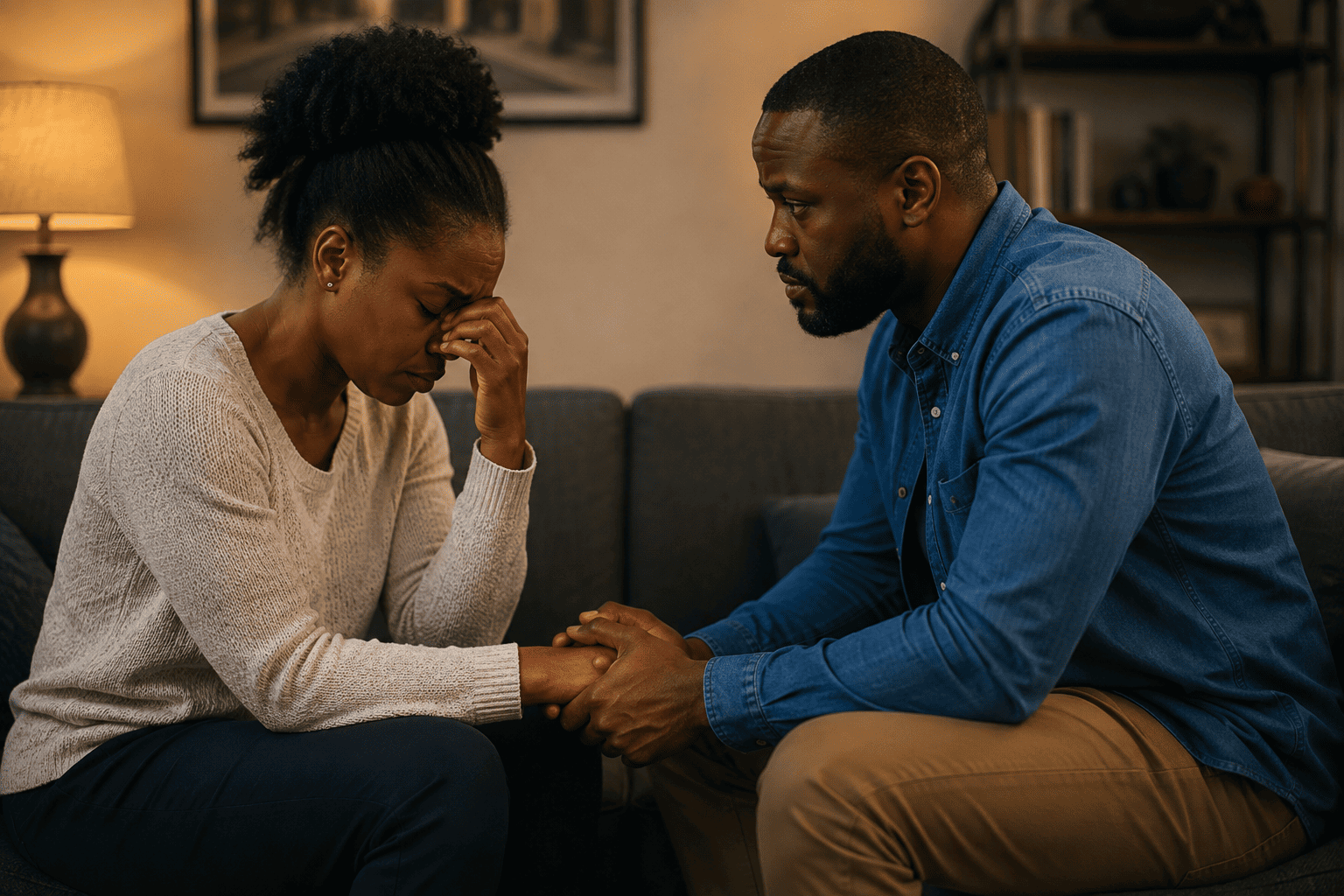
There is a particular kind of advice that gets offered to couples after a betrayal, usually with sincerity, and usually within days.
Forgive and move on. Don’t keep bringing it up. Let go and let God. What’s done is done — focus on the future.
Every one of those sentences contains something true. Together, they describe a strategy that fails almost universally, because they all point the same direction: pretend it did not happen, as quickly as possible.
Couples who actually recover do close to the opposite. They go through it rather than around it. It takes longer, it is more painful, and it works.
First: what kind of betrayal are we talking about
The word covers a wide range, and the path is different depending on which one you are facing.
Sexual infidelity is the one most people mean. It carries the sharpest shock and often the most public shame.
Emotional affairs are frequently more devastating than people expect, because the injured spouse is told nothing physical happened, and is therefore expected not to feel it. The intimacy that was given away was real.
Financial betrayal — hidden debt, secret accounts, money given to family without disclosure, a business failure concealed for months. This is enormously common and rarely discussed, and it damages trust in exactly the same way.
Ongoing deception about anything significant. Some couples discover the lie was not one event but a structure that had been running for years.
The mechanics of rebuilding are broadly similar across all four. Where they differ, it is worth noting.
Why “just forgive and forget” fails
Forgiveness and trust are two different things, and conflating them is the single most common mistake in Christian responses to betrayal.
Forgiveness is a decision the injured party makes about their own posture — releasing the right to punish, refusing to let bitterness take root. It can be given relatively quickly, and it is commanded.
Trust is a conclusion drawn from evidence. It is rebuilt slowly, by observation, over time. It is not commanded, because it cannot be manufactured by will.
You can forgive someone entirely and still not trust them with your phone password. Those two things are not in conflict. A church culture that presses an injured spouse to demonstrate forgiveness by immediately restoring trust is asking for something that is not theirs to give — and that pressure, more than anything else, is what drives injured spouses to fake recovery while the wound stays open.
Say it plainly to yourself if you are the one who was betrayed: I am working on forgiving you. Trust will take longer, and that is not a failure of forgiveness.
What the person who betrayed has to do
The burden here is asymmetric, and pretending otherwise stalls recovery. The person who broke the trust does the majority of the work of rebuilding it.
Full disclosure, once, completely. The most damaging pattern in recovery is drip-feeding — a partial admission, then another detail two weeks later, then another. Every new revelation resets the clock to zero, because it proves the last account was incomplete. One difficult conversation with everything on the table is far less destructive than six months of staggered discoveries.
End it completely, and let that be verifiable. Not “I’ve told them we can’t talk anymore.” Contact ended, blocked, and the injured spouse able to confirm it.
Voluntary transparency, offered rather than demanded. Passwords given without being asked for. Location shared without a request. Schedules explained before questions arise. The point is not surveillance — it is that transparency offered freely is evidence of a changed posture, while transparency extracted under interrogation is just compliance.
Absorb the anger without collapsing or retaliating. The injured spouse will be angry, repeatedly, for a long time, and often about things that seem resolved. Responding with “how long are you going to keep bringing this up?” communicates that the betrayer’s discomfort matters more than the injury. It will set recovery back weeks.
Answer the questions. Some of them will be painful and some will seem pointless. Answer them anyway, calmly. The injured spouse is trying to rebuild a coherent account of their own life, because part of what was taken was their ability to trust their own perception.
Do the underlying work. Whatever made this possible — a pattern of secrecy, an addiction, an unaddressed emptiness, a habit of avoiding difficulty — has to be dealt with directly, usually with help. A betrayal treated as a one-off mistake rather than an outcome of something tends to recur.
What the injured spouse has to navigate
Less work, but harder terrain.
You are allowed to grieve. Something did die — a version of your marriage, and your assumptions about your own history. Grief has stages, they are not linear, and the sudden return of rage in month seven is normal rather than evidence of failure.
Decide about checking, deliberately. Many injured spouses go through a period of searching phones and accounts. It is understandable and it is usually necessary for a while. But it is worth setting a term on it — I will check as much as I need to for the next three months, and then we will review — because indefinite investigation becomes its own prison, and it can quietly replace the work of actually deciding whether to stay.
Do not decide the future in the first month. The early period is not the time to determine whether the marriage continues. You are not thinking with your whole mind yet. Decide only the next step.
Tell one or two people, carefully. Isolation makes this immeasurably worse. But choose people who will support your marriage rather than campaign against it, and be aware that anyone you tell will remember this long after you have moved past it.
Do not perform recovery for your church. The pressure to appear restored, particularly in ministry families, causes enormous damage. Take the time you need in private.
What actually rebuilds trust
Not grand gestures. Not a holiday. Not an emotional apology, however sincere.
Trust rebuilds through small promises kept, repeatedly, over a long period.
He says he will be home at six, and he is home at six. She says she will show him the bank statement on Sunday, and on Sunday she shows him. He says he will go to the counselling session, and he goes to all of them, including the ones after things improved.
Each kept promise is a single data point. Trust is what emerges when enough of them accumulate that the injured spouse’s nervous system stops bracing. That takes hundreds of data points, which takes time — most counsellors describe eighteen months to two years for serious betrayal, not weeks.
This is unglamorous and it is the whole mechanism. There is no shortcut, and every attempt to find one extends the timeline.
Getting help
Most couples cannot do this alone, and the ones who try often stall.
A trained counsellor gives you a structured place to have the hardest conversations, which stops them from detonating at eleven at night. If you can access professional marriage counselling, particularly someone experienced with infidelity or financial betrayal, take it.
If cost is a barrier, some churches have trained counsellors, and some counsellors offer sliding-scale fees. Be honest about whether the person you approach has actual training — a well-meaning pastor without it may give advice that pressures the injured spouse into premature reconciliation.
When rebuilding is not the right goal
This article assumes both people want the marriage. Sometimes that assumption does not hold, and it would be dishonest to write as though it always does.
If there is no genuine remorse. A spouse who minimises, blames the injured party, or admits only what was proven is not in a position to rebuild anything. You cannot restore trust unilaterally.
If the betrayal is ongoing. Recovery cannot begin while it is still happening. This is not a moral judgement, it is a practical one.
If there is abuse. If the relationship involves physical violence, threats, or a pattern of control and intimidation, this is not a trust-rebuilding situation and the advice above does not apply. Reconciliation counselling with an abusive partner can increase danger. Speak to a domestic abuse organisation rather than a marriage counsellor, and do it from a device your partner cannot access.
If staying is destroying you. Christians are sometimes taught that leaving is always the greater failure. Whatever your theology of divorce, a person being slowly dismantled is not what any of it was designed to produce. Get outside counsel from someone who knows your situation in full.
The honest ending
Some marriages come through betrayal and end up more honest than they were before — not because the betrayal was good, but because it forced conversations the couple had been avoiding for a decade. Couples who reach that point almost never describe forgetting. They describe a scar that is genuinely healed, and genuinely still there.
That is the realistic goal. Not a marriage where it never happened. A marriage where it happened, was faced completely, and did not get the final word.
If you are at the beginning of this, do not aim at the whole distance. Aim at this week: full disclosure, no drip-feeding, one kept promise, one honest conversation, and help from someone qualified.
That is enough for now.
If you are experiencing abuse, contact a domestic violence support organisation in your country. In Nigeria, the Lagos State Domestic and Sexual Violence Agency operates a helpline, and organisations such as Project Alert and WARIF provide confidential support.